Showing posts sorted by relevance for query tire pressure. Sort by date Show all posts

Sunday, May 2, 2021

All About Tires


Tire Pressure The correct pressure to carry in your tires is probably the most misunderstood topic concerning vehicles. Let's start by stating the correct pressure is NOT the max pressure on the sidewall. Anyone that tells you different is full of it.

The correct pressure is determined by weighing each axle and consulting the tire manufacturer for the pressure for that weight. Search for 'suggested tire brand rv tire pressure'

Weighing the RV You need to know the weight on each wheel, each axle, and the all-up weight. The LD should be weighed with the gas and propane tanks full and the freshwater about 1/2 full and the storage tanks empty. All gear normally carried and all humans should be aboard for the weigh-in. You should seek out a segmented scale, rather than a platform scale. Commercial truck stations have such scales.

Knowing the axle weights you then refer to your tire manufacturer's recommended pressure for those weights.

Here's an illustration for Michelin XPS RIB's 


If the front axle weight is 4,200 and the weight is equally distributed left to right (and it should be reasonably close) then each tire is supporting about 2100 pounds so the proper pressure should be 60 pounds. 

If the rear axle weight is 9,600, then each tire is supporting about 2,400 pounds so the proper pressure should be 70 pounds.

(Note if the tires were arbitrarily set to 80 pounds each that would support over 15,000 pounds which exceeds the Ford chassis rating of 14,400. Expect wearing on the center of the tire)

Having the correct tire pressure was brought, almost forcibly, home to me after having Michelin XPS RIB's installed. I set the pressure according to the Michelin specs for my axle weights. Except I confused 55 with 65 in the front tires. This caused the front end to "float". The rig would wiggle around on the road above 50. It was fine without the Jeep, but the force of the Jeep on the rear end actuated the sway. After adding 10 pounds to get the correct pressure of 65 it returned to its normal tracks like a train mode.

I have heard many owners complain about sway. They added rear sway bars. I wonder if the sway bar just masked under inflation? I think I know the answer.


Tire Stems

Consider installing long, specially configured brass valves; these valves make checking tire pressure and airing the tires much easier! (These are NOT tire stem extenders, which many consider dangerous) They are available from several sources. Search for Borg valve stems. Today I see them at
https://www.shinyrv.com/product/dually-valve-stem-kit-for-class-c-ford-e350-e450-dl1ec-free-shipping/


Metal Valve Caps - Spend $5 and get them (Required on commercial trucks) Take them off when you get your tires changed as they will vanish)


ABOUT YOUR TIRES  (UPDATED 2022)


READING A LIGHT TRUCK TIRE SIDEWALL


Rub a piece of chalk over any markings that are difficult to see/read; the chalk makes the letters stand out.  


  • LT = light truck  (Not all “light truck” tires are appropriate for RV use!)  
  • 225/75R/16E is the tire size on the Ford E-450 chassis.  '225' is the tire’s width in millimeters.  '75' is the aspect ratio, i.e., the relationship of the sidewall height to the tire width; the sidewall height is 75% of the tire width.  'R' indicates a radial tire.  '16' is the diameter – inches – of the wheel (rim).
  • Load range relates to the maximum load an individual tire can carry; on LT tires, a letter indicates the load range, e.g., D or E.  
  • The maximum load capacity for the individual tire (stamped on the sidewall of the tire) is indicated as 'X' pounds when the tire is used as a single.
  • The tire’s maximum cold pressure is indicated near the maximum per-tire load ratings.
  • Tire markings vary according to the manufacturer, but the tire’s description/specs should include its intended use, e.g., commercial, highway all-season, etc
  • The number and composition, i.e., polyester or steel, of belts under the tread and plies in the sidewall are (usually) indicated near the tire size marking.  E load range tires should be 10-ply.
  • The date of manufacture of the tire is located in one of the 'DOT boxes', small rectangles containing the tire’s identification, serial number, etc.  Beginning with the year 2000, the manufacturing date is indicated by a four-digit number; the first two digits represent the week of manufacture, and the last two digits show the year of manufacture.  For example, '3519' means that the tire was made during the 35th week of 2019.


TIRE TIPS


     Tire Rack offers the most comprehensive, updated listings of available LT225/75R/16E tires. Search tire listing websites by tire size, not by vehicle.

https://www.tirerack.com

All-steel, i.e., steel mesh belting and sidewall reinforcement can be a good choice, but the selection is (currently) limited to two manufacturers. 

Michelin XPS Rib

Goodyear G947 RSS Armor Max, G949 RSA Armor Max


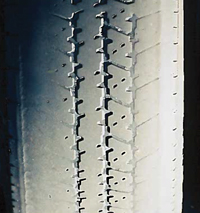
Tire wear patterns indicate over/underinflation, poor wheel alignment and balance, damaged wheels, and/or suspension problems.   

Over-Inflation Wear

Tire wear in the center of the tread pattern tells you that the inflation patterns are too high. Too much pressure can cause the contact patch to shrink and the center of the tire to carry all of the load.


Under-Inflation Wear

Tire wear on the edges of a tire will typically indicate inflation pressures are lower than specified. When a tire is under-inflated, the contact patch grows and the load is carried by the outside edges of the patch.

Feathering

The indicator of excessive positive or negative toe angle is a feathering or scuffing that can be detected by stroking your fingertips across the edge of each tread bar or tread block. A feather edge on the inside of the tread bar indicates excess toe-in, while a feather edge on the outside of the tread bar indicates toe-out. Because the angle is affected by changes in camber and caster angles, it’s always the last angle to be adjusted during the wheel alignment process. In addition, any change in camber or caster angles will immediately change the toe angle. Toe angle geometry can also be greatly affected by changes in suspension height.

Scalloped

Cupped or scalloped dips appearing around the surface of the tread could indicate loose, worn, or bent suspension parts. Worn shock absorbers or unbalanced tires can also cause cupping, but the cupping would typically be more indicative of a concentric pattern. Shocks and struts are the most likely culprit because they provide damping force to control tire movement. When the tires move excessively, the scalloped pattern can appear. A lack of rotation can cause this condition.


Outer Edge Wear

Wear on the outer edge of a tire is rare these days, but it does happen. Positive camber, caster, and toe can lead to wear on the outer edge. If you see edge wear on one side, check the thrust and setback.

But, it should be noted, that the leading cause of outer edge wear on modern vehicles is over-enthusiastic cornering.


 Inner Edge Wear

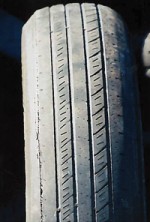
Inner edge wear on tires is the most common problem most technicians see. The angles causing this type of wear are typically negative toe and camber. For parts, there are three component sources of the inner edge wear: bushings, springs, and loads.

  •  Bushings

Ozone, extreme temperatures, and other atmospheric issues tend to destroy rubber bushings and cause the alignment angles to change. Some vehicles have hydraulic bushings on the rear lower control arms. Some bushings will leak when they fail. When a bushing in the rear fails, the extra movement causes the wheels to toe out and the camber to go negative.

  •  Springs

As a suspension compresses and rebounds, the alignment angles change. Engineers tune alignment angles for a specific ride height to maximize handling and tire wear. If a spring can no longer support the vehicle, the alignment angles will suffer. Most engineers tune the suspension to toe out when the rear suspension compresses. This increases vehicle stability. But, it also causes the inner edge of the tire to wear. Springs are made of metal that is heat-treated but can still fatigue. This includes leaf, coil, and torsion bar springs. If you see a vehicle that needs considerable adjustments for camber on both wheels of the same axle, inspect the springs.

  • Loads

Loads in the rear of the vehicle will cause changes to the toe, caster, and camber in the front (and possibly the rear). The camber and caster will become positive in the front, and if the vehicle has an independent rear suspension, the camber will become negative and it will be toed out. This could lead to outside edge wear in the front and inside edge wear in the rear.

Chalk Test - You can visually determine if the tires are over or under-inflated with what is known as a chalk test. There are numerous YouTube and explanatory articles that can be found by searching for ‘chalk test’. All you need is a piece of chalk, an empty parking lot, the rig loaded as it would be going down the road and 15 minutes.


Use the recommended tire application, size, and load rating for your RV


    Look for the certification sticker on the door jamb of your LD; it contains information about tire size/type, recommended tire pressures, and tire weight capacities.


Light Truck is the somewhat confusing tire designation used for tires that are the appropriate size and application, i.e., designed for commercial or RV use, for your E-350/450 chassis.


Commercial grade/RV tires are often made of better grades of rubber, contain more UV and ozone protectants, and may have additional plies of polyester (or another material) in the sidewalls, and/or extra belts under the tread; these are usually steel 'mesh'. 


Use the appropriately-sized tire for your wheel.  Using even a slightly wider tire than the 225/75R/16E, i.e., a 2/5” larger 235/75R/16, reduces the amount of space between the duals.  Less space means excess heat build-up and possible blistering (and weakening) of the tires’ sidewalls.  


Also, 'non-spec' space between duals leads to possible contact between the duals when the tires flex during normal use; contact can cause the tires to 'scrub' and weaken the sidewall.  (And, the wider tire may not form a thorough seal when seated on the rim.) Never install a 16.5” (bead width) tire on a 16” rim, or vice versa.


Load rating E is the appropriate choice for the E-450 Ford chassis.  

Currently, Michelin, Goodyear, Bridgestone, Kumho, Toyo, and B.F. Goodrich are among several manufacturers that offer at least one LT/225/75R/16 E-load range tires that are appropriate for use on the E-450 chassis.  Check each manufacturer’s website for tire choices of the appropriate size, load rating, and application; the availability of tire models and applications changes frequently! 


Note:  The 'M+S' tire tread designation means that the tread grooves are wide and begin close to the outside edge of the tire; the wide tread grooves allow mud and snow to be thrown off more easily than from a narrow-grooved highway tire.  Sipes, usually hook-shaped or zig zag slits around the outer edge of the tire tread, provide increased traction on wet roads. M+S tires are not true snow tires; they are classified as all-season tires, suitable for a variety of road applications. 


        The most common causes of tire failures are overloading and underinflation.  


Weigh your coach, loaded and ready for the road, on all four 'axle corners'; the weight (of each corner of) your coach determines the inflation pressure(s) of your tires.  


All tires on the same axle should be inflated to the same pressure; if there is a weight discrepancy between the right and left side of the RV, air the tires to accommodate the higher weight.


Don’t exceed the maximum cold tire pressure, stamped on the tire sidewall (or the GVWR of your coach!)  If your weight indicates a tire pressure over 70 pounds, remove the rocks and scrap steel you are grossly overloaded.


     Load Rating Tables

Individual tire manufacturers’ websites offer tire care tips, application, size, load rating information, and inflation tables for their tires; check selections among LT225/75R/16E Examples of load rating tables.


https://www.michelinrvtires.com/reference-materials/load-and-inflation-tables/#/


www.goodyearrvtires.com/tire-inflation-loading.aspx


A closer look at a load range table. Using the Michelin XPS Rib as an example.


If the front axle weight is 4,600 pounds, then the proper inflation would be 65 pounds. (2,300 per tire x 2)

If the rear axle weight is 9,200 pounds, then the proper inflation would be 75 pounds.

(Note 4,600 + 9,200 is 13,800, the typical weight of a 26-foot going down the road with full gas, 2/3 water, and empty storage tanks)

Make sure you are typical and get it weighed.


TIRE MAINTENANCE


Inspect your tires regularly; don’t forget the inside duals!  Check the sidewalls for cracking, checking, bulges, tears or (excessively) scuffed areas.  (Also check the tire bead area for any gouges or shredded or missing rubber.)  Check the tread for tread depth, uneven wear, rocks or other road hazard debris, and any cuts or areas of missing rubber.


Tires deteriorate much more quickly when exposed to UV light and ozone in the air; wash tires with mild soap and water and rinse thoroughly.  Keep tires covered while the RV sits in storage or at a campsite.


Do not use tire dressings or vinyl/rubber treatments containing petroleum distillates, e.g., Armor All, on your tires or any vinyl or rubber surface; using these products can actually increase the rate of deterioration.  303 Aerospace Protectant is the good stuff!   https://www.goldeagle.com/brands/303-products/


RV tires should usually be replaced when the tires are about 5-6 years old, even if the mileage is low and the tread still appears good.  The sidewalls of RV tires are far more vulnerable to the effects of weight and wear than the tread, and time and exposure can deteriorate tires faster than use.


Tire Stores - You should seek one that normally handles larger vehicles. 


Install long brass valves; these valves make checking tire pressure and airing the tires much easier!  Search for dually tire valves or Borg tire valves.


http://yourtireshopsupply.com/category/796/dually-valve-kits is one source for these valves. These are NOT extensions, which can be dangerous.


Carry a reliable, accurate truck/RV tire pressure gauge that registers tire pressures up to about 100 pounds.  The pencil types are less accurate than numbered or digital read-out gauges.  Make sure that the gauge head is deep enough to allow a complete seal around the tire valve when you check the tire pressure.  Do not rely on the gas station or even tire shop gauges that are attached to the air hose; these are notoriously inaccurate.  


Make sure that the gauge selected is for truck/RV use, i.e.; the gauge needs to measure high enough pressures and be of a configuration that allows you to reach the valves to check the air pressure. I use an Accutire MS-4021B Digital Tire Pressure Gauge; see Amazon. Jayco is another quality vendor. A flexible hose is a plus.


Besides the gauge, other handy tire tools are a valve core tool, extra valve caps, an old (dull) screwdriver to pick rocks out of the tread, and a depth gauge measure.


Check your tires’ air pressure before each day’s driving; the tires have to be cold for an accurate reading.  'Eyeballing' does not substitute for using the gauge to verify correct tire pressures!


A laser digital thermometer is useful to quickly check tire pressure/temperature at a rest stop. You just walk around the rig and shoot all six tires noting the temperature. You will quickly learn what a normal temp is. The inside dual will always read a little higher than the outside.  80 to 120 degrees depending on ambient temp are normal.


Use metal valve caps to keep dirt, debris, and moisture out of the tire valves; these can damage the valve core and cause a slow leak.  The best 'air-through' valve caps are German-made V2B Alligators: 


https://shop.myerstiresupply.com/ERP2Web49/e2wItemMain.aspx?parentId=00083256


https://www.amazon.com/Alligator-V2B-Inflate-Through-Valve/dp/B014VCY3S2


Depending on speed, ambient temperature, and length of driving time, a tire can inflate to several pounds over its cold inflation (even exceeding the maximum) pressure.  This is normal; never bleed air from a hot tire.


Carrying a small 120V (or capable 12V) air compressor makes airing the tires much easier! 

400P-RV AutomaticPortable Compressor is an example.

https://www.viaircorp.com/portables/400p-rv-auto


If you use wooden or plastic blocks for leveling your coach, make sure that the blocks are wide enough and long enough to support the entire footprint of the tire!


https://trilynx.com/


Always block both rear duals when leveling the coach; never block just the outside dual.  


Air the spare to the maximum pressure listed on the sidewall.


Monday, November 20, 2017

Tire Pressure Management Systems (TPMS)

Tire Pressure Management Systems (TPMS)

The following discussion was compiled from a long thread about TPMS on the Lazy Daze Owners' Group forum. Various TPMS brands have been bolded.


We have TPMS from Tire Safeguard. Flow through for LD and not for the toad. Have been very satisfied, especially with the telephone support when monitors got out of sync and technical spent about 1/2 hour helping to re-sequence. Kudos.

Tom


From Technomadia:

Tire Pressure Monitoring Systems (TPMS) for RVs - Why the EEZTIRE is Our...


We recently purchased the TireTracker system at a Rally in Indiana. It is a different system compared to one pictured in the link. We haven't installed it yet but plan to do so in the very near future, It was an expensive purchase but something we just felt we couldn't live without any longer. It has some features we liked including a notification when tire temp suddenly changes, alerting the driver to a potential problem. Jeff from RV safety came across as knowledgeable and credible at the various rally presentations he made on safety.  


I would not be without one.  I have been happy with my PressurePro TPMS.  It has been on for 9 years now. I bought it before I took delivery of my '08, and have had the sensors, with non-replaceable batteries, in place since then.  Around year 2, I had a sensor go bad.  It was replaced, no cost, under warranty.  At 7 years, in very cold weather, I had a sensor (1 of 10) that would be slow to register, and would occasionally lose its connection to the monitor.  So, with 7 years on the sensors and an expected life of 5 years, I replaced all the sensors.  I am at 9 years on the system, with no other issues.  As Larry said about his system, programming the sensors is annoying but other than needing to press the buttons just right, is not onerous, particularly since I have only needed to do it a few times in 9 years.

I should note that I set my tire pressure with a digital pressure gauge.  That gauge agrees with the two analog gauges on my compressor, e.g., I can set them at 80 psi, let the compressor charge the tire, then check the tire and I read 80 psi.  However, the reading reported by the sensors can vary by several pounds.  That really doesn't matter, because the sensors are intended to measure and report a CHANGE in tire pressure.  They do a good job of that, and as the programming is individual sensor rather than group programming, if a number reading is off by a few pounds, that is of no consequence.  A loss of pressure on one sensor will be reported as quickly as a loss of pressure on another and is a function of percentage pressure change.  There is an old expression - "Man with one watch knows the time.  Man with two watches never sure."  As the sensors are highly reliable in detecting and reporting pressure changes, but not as much in reporting actual pressure, I do not use them to set my tire pressure.  I make the tire pressure right and use the tire pressure to set the sensor.

My TPMS, PressurePro, does not require a pre-departure scan.  Once I turn it on, it takes a few minutes before every sensor "logs in" to the monitor.  Once they do log in, any low values set off an alarm.  Pressures are subsequently checked by the sensors every few seconds.  If a pressure falls outside of the range, an alarm is immediately sent to the monitor.  If all is ok, each sends pressure information to the monitor every few minutes.  It is no distraction unless an alarm goes off, but that is something I would want to know.

In 9 years of full timing, I have gotten one alarm from a failed sensor, and I have seen a number of first things AM alarms where a tire pressure is down a few pounds, due to the cold weather overnight.  The pressure in the low tire is displayed, allowing me to decide if I need to pull out my compressor, or if it is OK to roll.  Case in point, currently my TOAD pressures are reading 29 to 30 in the morning, and I usually take them up to 33.  So, the alarm goes off, I look at the readings, and I silence the alarm.  It will repeat in a few minutes if the pressure stays low, but usually, a mile of driving brings the pressure up to my "OK" range.

When you check the pressure in the morning before starting out, you travel, knowing ONLY what the pressure USED to be.  With a TPMS, you know what the pressure is, all the time.  For some, they see no need for a TPMS.  I would not travel without one.

My TPMS, PressurePro, does not require a pre-departure scan.  Once I turn it on, it takes a few minutes before every sensor "logs in" to the monitor.  Once they do log in, any low values set off an alarm.  Pressures are subsequently checked by the sensors every few seconds.  If a pressure falls outside of the range, an alarm is immediately sent to the monitor.  If all is ok, each sends pressure information to the monitor every few minutes.  It is no distraction unless an alarm goes off, but that is something I would want to know.

In 9 years of fulltiming, I have gotten one alarm from a failed sensor, and I have seen a number of first thing AM alarms where a tire pressure is down a few pounds, due to the cold weather overnight.  The pressure in the low tire is displayed, allowing me to decide if I need to pull out my compressor, or if it is OK to roll.  Case in point, currently my TOAD pressures are reading 29 to 30 in the morning, and I usually take them up to 33.  So, the alarm goes off, I look at the readings, and I silence the alarm.  It will repeat in a few minutes if the pressure stays low, but usually a mile of driving brings the pressure up to my "OK" range.

When you check the pressure in the morning before starting out, you travel, knowing ONLY what the pressure USED to be.  With a TPMS, you know what the pressure is, all the time.  For some, they see no need for a TPMS.  I would not travel without one.

Ken F 


TST (Truck System Technologies). We have used this system for a number of years on two RV's. Works just fine. I change the batteries each Spring simply to avoid having to change them on the road should they fail. Much easier to do at home at my convenience with all the tools I might need.

TST 507 Flow Thru Kit - Tire Pressure Monitoring Systems - Truck System...

"How much space does the read out gizmo take on the dashboard?  He has a Scan Gauge up there now."
Can't speak to all brands, of course, but the general answer to your question is 'not much'. Perhaps an area say 3' long by 1" deep. And it doesn't have to be right in front of the driver's eyes either, especially if there is a passenger to keep an eye on it now and then. I have a Scan Gauge, GPS and a TPMS and they all get together just fine.

"Can the sensors be put on if one has the air-thru filler valves, or do these sensors replace the filler valves?"
The sensors replace the valve stem cap.

"Limited physical acuity will probably preclude self-installation, unless it is really easy to do.  What sort of dealer (tire?) should we contact, if needed?"As long as a person in your group can check the tire pressure now, they can install any of the TPMS systems. You just remove the existing cap and screw these in their place. However, sometimes, depending on the type of decorative wheel covers you have, the length of the valve stem and the size of the sensor, it may be necessary to enlarge the hole on the cover to accommodate the sensor. I had to do this to the two front wheel covers on my 2015. The holes simply were not large enough. Now I could have added a short extension to the valve stem to get it further out, but I really didn't want too. A drill with an abrasive attachment made quick work of making the hole larger. Plus I'm guessing that some of the metal I ground off would help offset the additional weight of the sensor.


The first set of sensors we had did not have the flow-through stem feature. Before every trip,  I like to get the tire pressures balanced because tires simply lose air over time. With the old system, I had to take all the sensors off to do this.  Doable, but a PITA. The ones I have now have the flow-through stem so, before each trip, I just check the tire pressure with my gauge and use my pump to get everything just as I want it. A very convenient, time-saving feature.

Ed 


Hello all,
I had the experience yesterday of having a tire blow out on my Lazy Daze 26.5.  It was the left outer tire that blew as I hit something on the way south on I95.  I saw it and had tried to avoid it but no luck.  My TireTraker system did exactly what it was supposed to.  It started flashing a bright red light and beeping loudly warning me that I was losing pressure very quickly.  I have a hearing loss and I was still able to hear it quite clearly.  I drove slowly to the next exit and had the spare put on the camper.  While the spare was being installed (for $25) we got to witness the Eclipse within six miles of the center of the path.

Fortunately, I had ordered a TireTraker system last week and had it installed the night before I had the tire problem.  This is the first trip I have made with the TPMS and I am sure glad I had it.  Being able to check on what pressure was in which tire and see the individual temperatures is very helpful.  I am now a believer in TPMS systems and their value to RVers.  Had I not known what happened I would have had to pull off to inspect the damage and the traffic was VERY heavy going south on I95 in South Carolina at the time.  Stopping on the highway would have been a very dangerous option but I did not have to thanks to the TireTraker system.

I bought a TireTraker because I had heard about it from some close RVer friends who have had one for many years.  In the latest issue of an RV magazine, they reviewed all of the popular systems including the one I bought.  It was very easy to install as the manual was quite complete and easy to follow.  One of the reasons I bought this system is that the individual sending units attach directly to the end of the tire valve stem and weigh less than 1/2 an ounce.  I can add sending units when pulling a trailer. No having to remove a tire from rims or anything like other TPMS equipment I have seen.  The batteries are cheap and plentiful and can be changed without removing the sending units.  It is a well thought out system and I am sure glad I had put it on when I did.

When I purchased my system I was told by the representative of TireTraker that I would need their "Repeater transmitter" as our RV's have an aluminum skin.  That may be true with a trailer but the basic system worked just fine on my 26.5 LD and the signal strength was fine in my vehicle.

This little device made a potentially bad experience into a manageable one.  It kept me from having to stop on a crazy busy road and risking an accident.  It protected my family and my dear little Lazy Daze RV. That made it worth every penny it cost, to me.

I hope you never experience a blow out at speed as it gets exciting fast.  Having safety equipment like the TireTraker makes my confidence level go up a notch while cruising along at 70 mph on a busy highway.

I really liked how simple the TireTraker was to install. I installed the batteries on the sensors and screwed them on in place of the caps on the tire valve stems.  Next, I programmed the controller by identifying each sensor, it took less than two minutes to finalize the programming on the system.  I spent less than 10 minutes installing the entire system (including the repeater) myself and getting it setup.
My system uses a battery inside the receiver which will last for a month of everyday use they tell me.  The kit includes a charging adaptor that uses the cigarette lighter or you can use a USB port to charge it up.  The receiver is smaller than my iPhone 6.  One negative on the TireTraker is that you cannot leave the system plugged in continuously, the instructions tell you to charge it regularly but don't leave it plugged in 24/7.  The battery can be overcharged and damaged if left charging continuously.

The kit has a dashboard mount but I used a piece of Velcro to hold it in place.  In the kit are included a set of locks to secure the sensors from thieves if you feel it is warranted.  

Overall I have been very impressed with the quality of the TireTraker kit and it works great!  I have looked at several of the competitors and they all seem to be very nice as there are several ways to get the same information.I am handicapped and don't bend very well as I crushed five discs in my lower back.  Even with my limitations, it was very easy to install and setup.
Having a serious hearing loss I had to find a device that would get my immediate attention in times of emergency.   The receiver has a little red lite that flashes very brightly as well as a loud beeper.  When it went off I was immediately aware even with my limitations.

Safety equipment is a "must have", and since I do most of the maintenance on my vehicle it had to be simple to maintain as well for me to buy one.  There are some nice systems out there and I came close to buying a system with the blow through sensors but decided against it as it would require shorter valve extensions or having pressure pushing on the extension mounts.  I really did not want to have to remove wheels to install parts.  The system I have made it as easy as checking the pressure, just change the caps and the installation was practically done.  The programming was easier than putting the sensor caps on.

I am happy with my purchase and feel it was the best option for me.  I hope that you folks that are in the market for a TPMS have an experience like mine has been.  Life should be so simple all the time.  Good luck and safe travels.

Chris McCloskey


Like you, I too have the TST 507 flow thru...I just this year replaced the batteries, even tho they were still working fine..just thought that nearly three years of use might be pushing it, and wanted to do the replacements before needed, at my leisure...grin. 

I'm very happy with the system--and love the temp as well as pressure readings. Keeps me informed what temps are running especially when driving in the south west in 110 plus weather. 

I just had a "loss of air" on the infamous inside passenger tire..the alarm told me instantly there was an issue..got me stopped asap. 
The system has paid for itself several times over. 

Gini Free


Our Doran RV360 is still working fine after five years.

I wouldn't want to travel without it working.

Larry


I have the RV 360 as well. This trip west is had trouble with two sensors intermittently losing contact with the receiver.  I called the company and they confirmed my belief the batteries are getting weak.  The sensor life can be prolonged by (being more diligent than I) taking the sensors off when the RV is not in use.  I've had the system for 4-5 years.  I purchased extra sensors for the Subaru. I need to get metal stems for the car before adding the cars to the system. 

John DeCrema


Ed  G


Do you use a repeater with your setup, Ed?


Chris 

No. Not on our '08 MB and not on the TK. Never had a reception problem so far.
But I only have the sensors on the camper, not on the Jeep. The wheel style on my Jeep doesn't have holes large enough for the sensor without me adding an extension to each tire, which I rather not do.

I just keep the rear view camera on while driving and watch for black smoke which might indicate a flat tire on the Jeep. 

Ed 111 


We have the EEZ TPMS and tow a Subaru.  The monitor picks all 10 sensors within a few minutes and we've not lost a connection once it's turned on.  In other words, does not need a repeater.  This system gives us PSI and temperature readings for each tire with the capacity to change settings.  I'm liking this.

Ed G


If one gets the type of TPMS that plugs into a cigarette-lighter-style 12V outlet, the only installation that might be required are all metal valve stems and toad.  The monitor for the TPMS can just sit in a drink holder or some other pocket that can be reached by the cord.  They alarm if there is an issue, so you don't need to have the monitor "front and center" to watch for problems.  

For the dualies on the coach, you'll want to get the stems from someplace like Borg or Tireman, for the toad we used Discount Tire.  You do not want to attach the weight of the TPMS sensors to the end of a rubber stem or flexible extender; you want solid metal valve stems (and in the case of the inner rear duallies, you want the stems supported by a stabilizer as they stick through the outer dual rims). 

We generally advise against Camping World touching anything on a coach (although there is a handful of CWs that we have heard aren't bad.  That hasn't been our experience).

Michelle Cook


In response to Chip, the TPMS I purchased and am trying to decide whether to keep or return is a TireMinder Smart TPMS that uses one's phone for displaying tire data and alerts. It's a fairly new model.

The valve cap pressure sensors communicate with a TireMinder module that can be placed anywhere in the cab and which then communicates with one's phone via Bluetooth. Assuming it works, I like this approach because it means one less screen in the cab.

Also, the TireMinder module alone will signal an alarm with just a tone and a light. You thus can check the data on your phone only when needed, not having it as a constant presence, and distraction. This is much like how factory installed TPMS works on most cars.

Our LD is a 2003 26.5' Rear Bath and we tow a Jeep Wrangler.     

Terry Burnes


I use the TireMinder system.   Having worked as a Test Engineer in a past life I have a bit of understanding of lab vs real world situations.  I will not nor am I able to defend any company but having said that most folks don't read the spec sheets or have expectations of equipment that the company will never meet.  

For instance, I did not install the wireless booster so I expect that I will lose signal from the transmitters.  Also, there will be interference from assorted other wireless transmitters that a boosterless system will not be able to overcome.    Having read the spec sheet I understand the system is accurate to plus or minus 3%.  In the real world on my standard tire pressure of 75, it can read anywhere from 72 to 78 and still be within the range of 'normal'.  When you toss in the tire gauge itself you could have an error of another 2 to 5%.  If the 'errors' go in the 'wrong' direction you could have an error of 8% or more - meaning tire reading with your tire gauge could be plus or minus of 6 pds on my standard 75 tire pressure ie 69 to 81. 

So the question is should I buy a TPMS.  Frankly, I use my system because I'm lazy.    I will know when a tire goes flat - I'm very sure of that.  I use the system to 'check' the air pressure before I drive off.  Yes, there is a cheaper way, like going around with a tire pressure gauge but like I said I'm lazy.  This ensures in my personal life I 'check'.  My recommendation --  If you don't have an extra 300 to 400 dollars and you ALWAYS  check tire pressures before you drive off to save your money.  

Glen (colddog)


Other than the recent blowout, we have had a couple slow leaks. I'm more concerned about our toad's tires, there is no way of knowing what is going other than the view from the camera.

I know several LD owners who had flats on their toads and never knew about it until they could see smoke or passing motorist flagged them down. 
One toad burned to the ground. Preventing this alone made the purchase
worthwhile.

One thing I love about the TPMS is NOT having to daily manually check the tire pressure, It takes about ten seconds to scroll through the ten tires, on the TPMS's monitor. It a real pleasure to use on a cold, rainy morning. 
Not having to manually check the pressure prevent any air from being lost, during the checking, which can add up on a long trip and require adding air. I rarely add air while on the road.

I would not want a system that uses my cell phone as it's monitor, preferring it to be completely stand-alone, so nothing needs to be done other than turning on the ignition. Make it as easy on yourself as possible is my logic. YMMV

Larry


Our TPMS-TireMinder TM66 has a wireless Signal Booster. Prior to setting up the booster when I originally installed the system, I got several "warnings" of both air pressure and temperature failures. 

Since activating the booster, I have had no false warnings and one warning of a lost signal from a sensor (battery failure). 

If the rig has been sitting in the driveway for a couple of weeks or more, I will check each tire manually. I use an analog tire pressure gauge manufactured for TireMinderwhich is stated to be within +/- 1 psi accuracy. The TM66 itself is stated to be within +/- 2.7 psi. This would suggest that there could be a variance of +/- 4.7psi. Is it perfectly accurate? Probably as good as others, I suppose. I have no issues with the system other than those I have mentioned.

While traveling, I rely on the TM66 monitor to determine air pressure before hitting the road. 

ONE THING: TireMinder states that a Scan of the Sensors be taken prior to departure. The manufacturer states that if the rig has been stationary for more than 9 hours a scan is needed to update the accuracy of the TPMS. It's a simple matter of pressing two buttons on the monitor and waiting about 20 minutes before departure. Then I check each tires pressure/temp via the monitor. Easily done and part of my travel routine.

I am not certain if other TPMS's need a pre-departure scan but it would seem to be a prudent action to take. If for nothing else, a little peace of mind.

Kent 


We started using a TPMS (Pressure Pro) in 2011.  We had a situation earlier where we discovered low pressure in a toad tire that turned out to be a nail, and if we hadn't noticed the low-ish looking tire, we likely would have done damage.  That tire needed repair, and a TPMS would have shown that slow leak.

Our initial experience with PressurePro was frustrating.  One seal kept causing a tire to leak down.  We got new seals.  Another sensor failed bizarrely reading very HIGH pressures (in a construction zone.  In a torrential downpour).  The sensor continued to send odd readings even when removed from the wheel.  Tap it on the counter and the reading would change.  Pressure Pro had never heard of such a thing.

After replacing that sensor (and the seals in all the others), the system has been solid.  It actually alerted us to yet another nail in a toad tire.  We replaced all sensors in 2016 since a couple started failing (internal batteries).
At a minimum, we would always have a TPMS for a toad.  We also like having it for the coach.  Now, you do need to make sure you have one-piece metal valve stems on any wheel that has a TPMS sensor, and support any long stems with a proper stabilizing grommet (e.g. if you get Borg stems for the rear duals and they stick out through the holes in the outer duals).

Our research showed non-replaceable battery sensors were a little lighter than those with replaceable batteries, so that's how we chose our TPMS.  Less stress on the valve stems.  When the current sensors start to fail we'll revisit the TPMS options at that time.

N.B. - Valterra has purchased Minder Research, the makers of TireMinder.

Michelle Cook


I don't understand why you would remove them for manual air checks? That is one of the main purposes for having them. In the case of the LD, we use flow-through sensors and they are never removed except to replace batteries. On the Subaru, we use the non-flow through so they are removed when we have to air up the tires. While we should remove sensors when parked for any extended time to preserve the battery we never remove them. So, for over 9 years now we have had TPMS on our LD. 

On our previous model the Doran RV 360 we had battery failures which required the sensors be replaced. On the EEZ RV model, we have used since Jan 2014 we have had one sensor fail to work properly that was replaced under warranty and other than that no air loss because of a sensor.

The only alarms we have had are the occasional beep if the monitor temporarily loses a sensor. That is partly my fault because I don't have a regular schedule for replacing batteries. Recently, I set up the repeater to see if that completely eliminates that from happening but have only used it once so can't comment on that.

For me, TPMS is just another form of insurance and convenience. In my case, I hated checking air pressures every time we headed out.

All that said, I agree, that they aren't perfect but it works for us.

Jim C


Our Doran RV360 TPSM is almost five years old, with two of the sensors replaced due to failure. It has worked, without failing, since new and has stayed accurate

A repeater was added early on after losing contact, at times, with the inside dual tires.

The biggest problems have been the difficulty of programming and the limited pressure differential range. The Jeep's oversize tires often alarm low, on cold mornings, and can have a high-pressure alarm the same day, if driving on a hot day.
I have compared the Doran's accuracy to several digital pressure gauges and the sensors are within a pound or two of being the same. The Doran updates very quickly, even after being off overnight or days, useful for when adding air, which isn't very often.Not losing air every day, while testing, and tight Michelin tires, let us go for weeks or longer without adding air. In fifteen years, I have never used our 12-volt compressor, on the road, ordinarily airing up at home. I should plug it in some time to see if it still works :-)

The Doran's biggest fault is the non-replaceable batteries. On the plus side, 8 of the 10 sensors are still good after five years. I know folks, with TPMSs, that have needed to start changing their batteries after just a year. It would be interesting to know how many sensors fail due to battery cap seal leakage, before and after a battery replacement.

If towing, I fully recommend a TPMS, along with a rear view camera.
The piece of mind is worth the cost, IMO
No one ever said this was going to be cheap.

Larry


I first used a TireTracker several years ago which quit working after 3-years. I replaced that with the TST which has given me no problems in the last 6-years of use. The only difficulty was with the programming of the unit. However, the TST people easily assisted me by phone to finish the task. The tire sensors have replaceable button batteries and O-ring seals. Very easy to do. I did opt for the repeater that I placed on the back window of my RB and powered it from the light fixture above the toilet. Easy job. The tire pressures are within 1-3-lb. of my gauge. I used non-pass through sensors that require a special security wrench to remove. Still easy to do. TSTdoes offer the pass-through sensors. 
Mike, 2010RB

First, a big thank you to those who do the heavy lifting on the LDO forum and make it possible for newbies like me to read and learn from those willing to share their expertise and experience.

I think it had a lot to do with my positive experience using a few of the products and services recommended by others on this site during this recent string of unplanned LD related events over the past couple of weeks.

It started with installing the 2nd hand TST 507 TPMS that I found didn't work due to a broken antennae solder connection.

That led to an email to TST support, which promptly replied I could make a warranty claim since it was under 3yrs old or upgrade to the latest color version for $99.

Mike Benson, mbenson@tsttruck.com, said they are offering the new color monitor to existing customers at a "discount" and others if they call and ask.

Ordered a new TST 507 cap set that comes with a color monitor, 4 sensors, and repeater for $318 since I wanted 4 more sensors for the toad.  Plus I sent in the old one for the warranty claim and both arrived within a week.

Went to install the TPMS again before our trip and developed a valve stem leak on the outer curbside dually when testing out the new TPMS.

Dropped off the LD at Les Schwab in Elk Grove who replaced the valve stem for free but also put on a stem that was too short and not centered on the hole since they said that was all they had.

Left for the trip with the TPMS gadgets in the box and minus one wheel cover since it touched the edge of the new valve stem when installed.

Returned to S&B from a trip and checked the tire pressure the next day and discovered the valve stem on the inner curbside dually was broken off at the base.

Called Progressive Insurance partnered with USAA on the chance it was covered under the roadside assistance and it was.  The service tech showed up at the S&B within 30min of calling and put on the spare.

Called Six Robbless and ordered the DL1EC brass Dually valve kit for less than anywhere else I could find - you have to call since they do not list the valve stems on their site.  Received the tracking number via email within a couple of hours.

So, all in all, we got a ton of good info out of this event and trip.  Found out TST now has a color monitor, good support and warranty policy, Les Schwab has good customer service but should probably not be the ones to install the new valves without more direction, Progressive insurance partnered with USAA has excellent roadside assistance - at least in Sacramento area, Six Robblees has excellent customer service and prices, and the LD can go at least 5hrs and 250mi on half a dually though not recommended.

Sometimes things go your way - whew!

Rich Meek


I've been using the Tire Minder TM66 since we started traveling in our LD.  https://youtu.be/FA1ZHbWcEnc Along with the TPMS, be sure to pick up an accurate tire pressure gauge that you will need to insure the TPMS accuracy.

My first choice of pressure gauges was the Tire Minder Analog (needle style read out) gauge but found that accurately assessing the pressure very difficult. This required me to take the tire stem sensor of the TPMS off several times before I could find the right pressure. Very frustrating to say the least.

I recently purchased the Tire Minder Digital pressure guage and while I haven't used it yet I can only imagine how much easier it will be to see what pressure I have added to the tires.   https://youtu.be/DopVLHn1iyc

Picked mine up on Amazon for $25. it's the best price I have found for this particular guage. I believe the video states the guage is accurate to +/- 1 psi but the package states it to be accurate to +/- 2 psi. Still not bad and a better option than its analog kin.

A good TPMS is essential. Makes heading down the road so much more relaxing. You have enough to think about while driving your new LD. Like what's for lunch or where is the nearest Starbucks.

Kent H

Nov. 2017